



























INCOTERMS AND THE ACQUISITION OF THE SHIP FOR THE FOGO–BRAVA ROUTE
Before expressing an opinion, it is necessary to understand the subject matter. Purchasing a ship on the international market involves more than just negotiating the price, signing a contract, and transferring ownership. It is a transaction that requires specific knowledge of maritime law, international commercial law, marine insurance, and contract law.

It is in this context that INCOTERMS (International Commercial Terms) emerge—international rules developed by the International Chamber of Commerce, designed to establish the responsibilities of the seller and the buyer, particularly regarding costs, transportation, insurance, and the transfer of risks.
To understand their importance, one need only ask a very simple question: if a ship purchased in Norway and bound for Cape Verde were to suffer an accident during the voyage, who would bear the loss? The seller or the buyer? Who took out the insurance? Who receives the compensation? And at what point did the risk transfer?
These are not secondary issues. They are central issues in international trade.
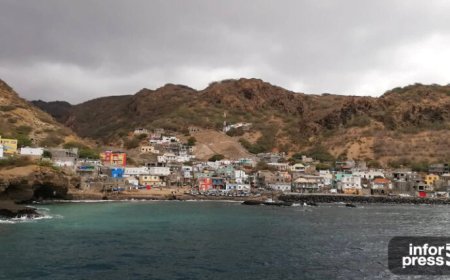
In the contract for the purchase of the vessel M/V “ØYKONGEN,” intended for the maritime connection between the islands of Fogo and Brava, it is evident that Clause 8 establishes obligations regarding the hiring of the crew, the vessel’s insurance, minimum coverage of 500,000 euros, and delivery at Porto Grande in Mindelo.
In turn, Clause 6 governs the transfer of ownership, linking it to the payment of the amounts specified in the contract.
However, it is important to distinguish between two legally distinct concepts: the transfer of ownership of the vessel and the transfer of the risk of its loss or damage. These do not necessarily coincide.
An analysis of the main contract does not reveal the express identification of any Incoterms 2020 rule, such as FOB, CIF, or DAP. This, in and of itself, does not render the contract invalid, since the use of Incoterms is not legally mandatory in all international transactions. The parties may directly establish their respective responsibilities.
However, in a transaction of this magnitude, it is essential that the risks, costs, liabilities, and delivery terms be unequivocally defined, from the ship’s departure from Norway until its arrival in Cape Verde.
There is also a technical detail that warrants attention: we are dealing with the acquisition of a vessel that sails under its own power, rather than simply goods transported by a vessel. Therefore, the mechanical application of rules such as FOB or CIF may not be appropriate. A specific clause regarding maritime delivery and the transfer of risk may prove to be legally more appropriate.
One final consideration is worth making.
Incoterms are not technical terms used to impress in a public discussion. Each rule has its own meaning, specific assumptions, and concrete legal and economic consequences.
Therefore, forming a scientifically grounded opinion on this matter requires a thorough understanding of the International Chamber of Commerce’s rules, their practical application, and how they relate to the sales contract, marine insurance, and the transfer of ownership.
It is not enough to know the acronyms. It is necessary to understand their content, distinguish between risks and costs, and know how to identify the legal consequences of each provision.
Public debate is legitimate and necessary. But freedom of opinion does not preclude scientific rigor, especially when international contracts and public funds are at stake.
In law, it is not enough to make a claim; one must provide a basis for it. In international trade, it is not enough to know the terms; one must understand the transactions. And when it comes to Incoterms, technical knowledge is not an academic luxury—it is a requirement of rigor for anyone who wishes to offer credible and enlightening opinions.
Olavo Francisco Franco Freire
*Master’s Degree in Maritime Law and International Trade