

































Brava: Favatal's photovoltaic solar power plant is now complete and connected to the public grid.
The Favatal photovoltaic solar power plant, on Brava Island, is now complete and connected to the public electricity grid, and generation tests began this week, the head of Águas de Ponta Preta (APP) announced today.
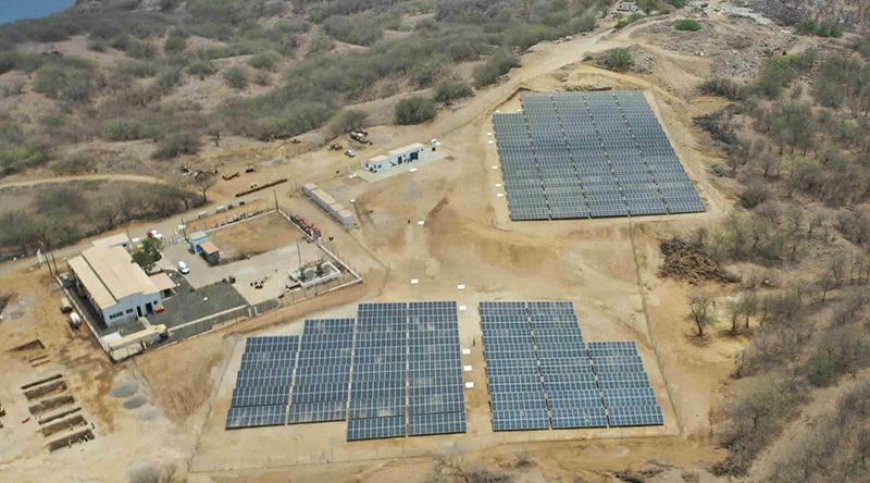
Speaking to Inforpress, Damian Pujol stated that the project, with an installed capacity of 1.3 megawatts (MW), should have its testing completed in the coming weeks.
However, full-capacity operation is contingent upon the completion of the installation of the battery storage system, a process that is also already underway on site.
Promoted by the Government, through the Special Projects Management Unit (UGPE), and financed by the World Bank with 148 million escudos, the infrastructure is part of a global package of 510 million escudos.
“The project also includes the construction of four other photovoltaic plants on the islands of Fogo, Santo Antão, Maio and São Nicolau. The plants on the latter three islands are already operational. The total investment planned for the five plants is approximately 510 million escudos,” explained Damian Pujol.
Despite the logistical difficulties encountered during construction, according to Damian Pujol, the Brava power plant was built within a year.
“The forecast is for an annual production of approximately 2,373 megawatt-hours (MWh), equivalent to about 70% of the island's electricity demand,” highlighted the APP representative, emphasizing that the plant has a capacity of 1,373 kWp and 1,300 kW in inverters.
With the infrastructure fully operational, it is estimated that there will be an annual reduction of 546 tons of fossil fuels, corresponding to a saving of 642,000 liters of diesel at the island's diesel power plant, and a decrease of approximately 1,800 tons in carbon dioxide emissions per year.
DM/CP
Inforpress/End