
























TACV crisis: private shareholders denounce violation of the law and warn of "governance vacuum" after General Assembly.
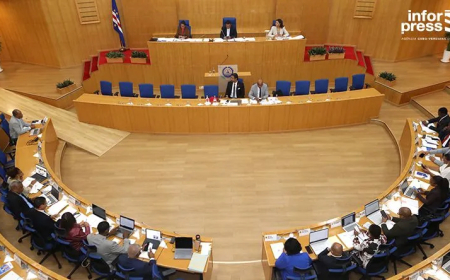
The private shareholders of TACV attribute direct responsibility to the state shareholder and the State Business Sector Monitoring Unit (UASE) for the impasse recorded at the General Meeting on October 16th, which ended without the election of the new Board of Directors that would be chaired by Mário Almeida. The lack of timely information about the new candidates for the corporate bodies and the attempt to violate the company's statutes are some of the flaws and irregularities denounced in a statement from these private shareholders.

The meeting, which once again ended without the election of a new management team for the Board of Directors, is described by participants as an episode demonstrating a "lack of preparation," which compromises transparency and plunges the national airline into a situation of "serious institutional uncertainty."
These shareholders also recall that the previous session, held on October 9th, had also been suspended in order to address similar irregularities.
Dismissal without succession and no compensation obligations.
The main point of friction and concern raised by shareholders was the decision to dismiss the current management, which still had about two years left in its term.
"According to the publicly released statement, the dismissal was carried out without ensuring the election of his successors, a circumstance which, they warn, cannot be equated to the mere termination of a term due to its expiration."
For private entities, the legitimacy of the removed managers to ensure day-to-day management cannot be presumed, and the transitional regime remains unclear in light of the company's statutes and the Public Manager Statute.
Additionally, they emphasize that, since this is a termination without just cause, the State will be obliged to pay compensation to all five departing directors.
Procedural errors and candidate rejection
Shareholders attribute direct responsibility for the impasses to the state shareholder and the State Business Sector Monitoring Unit (UASE). The criticism stems from the "continued non-compliance" with the right to information stipulated in Article 249 of the Commercial Companies Code, specifically the failure to provide, in a timely manner, the identification and profile details of the proposed candidates at the time of the meeting's announcement.
"It should be recalled that the previous session, on October 9th, had already been suspended in order to address similar irregularities."
"The outcome of the process reached a critical point during the proceedings when one of the nominated candidates formally declined to have their name submitted for voting, due to the fact that their remuneration had not been previously agreed upon," the statement emphasizes.
Attempt to reduce the size of the Board of Directors and recourse to the courts.
According to the shareholders, another censored episode involved the attempt to pass a resolution to elect only three directors.
TACV's private shareholders emphasize that "such a procedure directly clashes with TACV's statutes, which stipulate a governing body composed of five full members and one alternate, rejecting the possibility of altering or derogating from the statutory framework for the sake of convenience at any given moment."
Given the lack of regulatory conditions, according to the same source, the president of the General Assembly opted to suspend the proceedings, with their reopening contingent upon the formal submission of compliant and duly documented proposals by the Executive.
In closing their statement, the shareholders remind that the 90% majority stake held by the State does not exempt it from strict compliance with corporate law, nor does it grant it the right to diminish the rights of minority shareholders.
The private shareholders of TACV are therefore issuing a clear warning: "any resolutions passed in disregard of the law or the bylaws will be subject to legal challenge, with claims of nullity or annulment."
Daniel Almeida