











80$00 DI TXIPESA (The day I outran the bus)
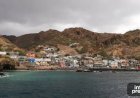
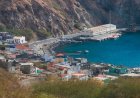
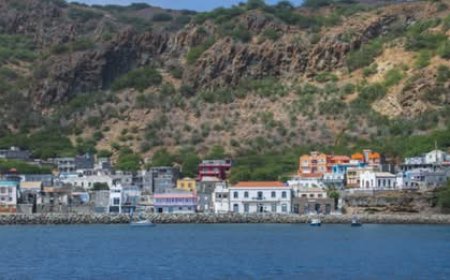
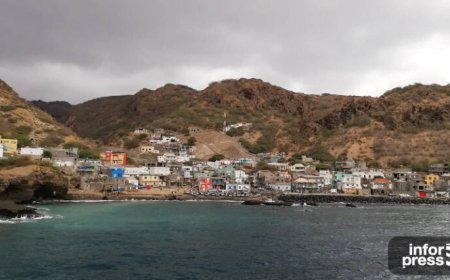
September 1999. The year the world feared the "Millennium Bug", but I, a 15-year-old boy from Ilha Brava, had a much more real fear: starving to death in the capital. I went to Praia to study, staying at the Madre Teresa de Calcutta Student Residence in Achada Santo António. There were about 80 of us students, a veritable Tower of Babel of accents from various islands. In the middle of that melting pot, there were only two Bravenses: me and my friend Adelmar.

Adapting was hard. Far from my mother's protection, I discovered that the concrete jungle had its own rules. The main one was about food. We had three meals a day, yes, but the law was clear: first come, first served.
I learned that the hard way. In the cafeteria, the usual dish was the famous "naughty rice". The menu said it was fish, but it must have been a hide-and-seek champion fish, because no one could see it on the plate.
You had to have faith.
If I blinked to make the sign of the cross before eating, when I opened my eyes, the only tuna bait floating in the broth had already flown onto the plate of my colleague from Tarrafal. There, I learned that every grain of rice counts and that fish was an urban myth.
Christmas came and, with it, the return to Brava. Paradise! Real food, the smell of the sea, the warmth of the family. But the vacations were over and, in January, the return to Praia made me cry. But this time, I was prepared. I swore to myself: "Hungry? Never again!"
My luggage looked like that of a war refugee, but a gourmet war refugee. I took everything: tins of camoca (gold powder), dried cakes, bags of cookies... a veritable arsenal. And, of course, my piano, because a man doesn't live on bread alone, he also needs art (and to impress the girls, of course).
The trip on the ship Sotavento was the usual odyssey. That boat didn't sail, it asked the sea for permission, slow as a turtle with rheumatism. Lying on the deck, I gazed at the stars, a philosopher, thinking about my academic future. My moment of Zen was interrupted only by the chorus of Fuegian ladies alongside, who shouted in tragic operatic tones with every swing of the ship:
- "Aiiiii nha má! Aiiiii nha pá!" - followed by a "gulp" that defied gravity. Pure poetry on the high seas.
Having arrived in Praia, I stayed at Aunt Amélia's for a few days. On Monday, the day to go home, I did the math. I had: a giant rucksack on my back, a heavy handbag, the sacred bag of food (can of camoca included) and the piano.
I paid for the cab: 100 escudos.
I paid for the bus: 20 escudos.
My bankrupt accountant's mind did the quick calculation: "If I take the bus, I'll save 80 escudos. 80 escudos is 4 days of snacks with bread and sweets outside the high school."
The "txipesa" beat logic.
I waited for the bus. When it stopped, it was already full. I got on, and that's when my presence was noticed. Not by the piano, but by the smell. The can of camoca wasn't sealed properly. The unmistakable aroma of roasted corn and sugar spread through the natural air conditioning of the open windows.
People started sniffing.
- "Kuse ki sta txera sima funji?" - asked a Senegalese lady.
I, cringing, pretended it was French perfume.
The driver, no longer patient with my "tetris" of suitcases in the aisle, ordered:
- "Boy, put those loads outside, in the side luggage compartment!"
I obeyed. I put my precious piano and my life bag in the belly of the bus. I kept my backpack on my back and the other bag in my hand. The journey continued to the Technical School stop. It was my descent. The bus stopped, a crowd got off. I got off, straightened my backpack, took a deep breath and turned around to get my things from the trunk.
But the driver must have been in a hurry for lunch. He heard the signal.
Tssss. Doors closed.
And then... ZUSSS!
Started.
My piano. My camoca. My life.
Everything disappearing in a cloud of black smoke.
I didn't think. It was survival instinct mixed with desperation.
The heavy backpack bounced on my back, hitting the back of my head with every step. The handbag swung like a murderous pendulum.
I ran.
I ran like crazy. I ran like a dog after a motorcycle. I ran as if the devil himself wanted to steal my lunch.
The scene must have been beautiful for those on the sidewalk. A skinny boy, loaded like a donkey, sprinting down Achada Santo António, shouting at a bus:
- "Hey! Stop! My piano! My camocaaaaaa!"
Sweat dripped down my forehead, my backpack felt like it weighed a ton, but the sight of going without food for a quarter gave me superpowers.
Unfortunately, 300 meters ahead, next to the Capelinha, the bus stopped to drop off passengers. I got there almost spitting out my lungs, red as a tomato, gasping for air. The driver looked at me through the rearview mirror, without the slightest emotion, while I shakily rescued my possessions.
I got everything back. The piano was intact. The camoca was saved.
But there, sitting on the sidewalk trying to catch my breath, I learned a valuable lesson in economics: because of the "txipesa" of wanting to save 80 escudos, I spent 300 escudos of shoe soles, lost 2 liters of sweat and endured an embarrassment that, if there had been YouTube at the time, today I would be a worldwide meme.
After all, it was cheap... and tiring!
The saying goes that laughter is the best medicine (and cheaper than a cab).
If my misfortune made you smile, share it! And while you're at it, tag that friend in the comments who would also run a marathon for a can of camoca!